
Beyond Static AI Memory
How AI Agents are Learning to Evolve Their Own Cognitive Architectures

Picture an AI that starts with basic memory and gradually develops its own sophisticated strategies. Not just learning what to remember, but how. It figures out on its own that conversations benefit from a different kind of attention than navigating a physical space. Nobody programmed those distinctions in. That’s MemSkill, and it represents something genuinely new: a shift from AI memory that is built by hand toward memory that teaches itself to evolve.
The Problem With How AI Memory Works Today
Every AI assistant with any kind of memory has that memory designed by a human. Someone decided what gets stored, when it gets retrieved, and how it gets organized. That design works reasonably well in the specific situations it was built for. It tends to fall apart everywhere else.
The problem is not that engineers are bad at their jobs. The problem is that the world is unpredictable. A system built to remember the thread of a conversation has no idea what to do when it suddenly needs to track a sequence of physical actions in a new environment. A system tuned for one kind of task stumbles when the context shifts. And as AI gets deployed in more varied, real-world situations, that brittleness becomes a genuine ceiling.
There is a deeper issue underneath all of this. We keep building AI with fixed memory rules and then expecting it to be flexible. It is a little like hiring someone and handing them a rigid script, then being surprised when they cannot handle a conversation that goes off-script.
Memory as a Learnable Skill
MemSkill reframes the problem entirely. Memory is not a fixed procedure. It is a skill, and skills can be learned, refined, and specialized over time.
In MemSkill’s framework, every memory approach is a structured skill with two parts: a sense of when to use it, and a method for how to apply it. The system builds up a library of these skills and gets better at deploying them as it accumulates experience. It is also not locked into processing one exchange at a time. It can work with a short back-and-forth or a long stretch of conversation, depending on what the situation actually calls for.
The skills are readable too. Each one is explicit about what it is doing and why, which means a human can look at them and understand what the system has learned. There is no black box.
The Two-Part Learning System
The real innovation is how MemSkill learns. Think of it as a strategist and an inventor working together.
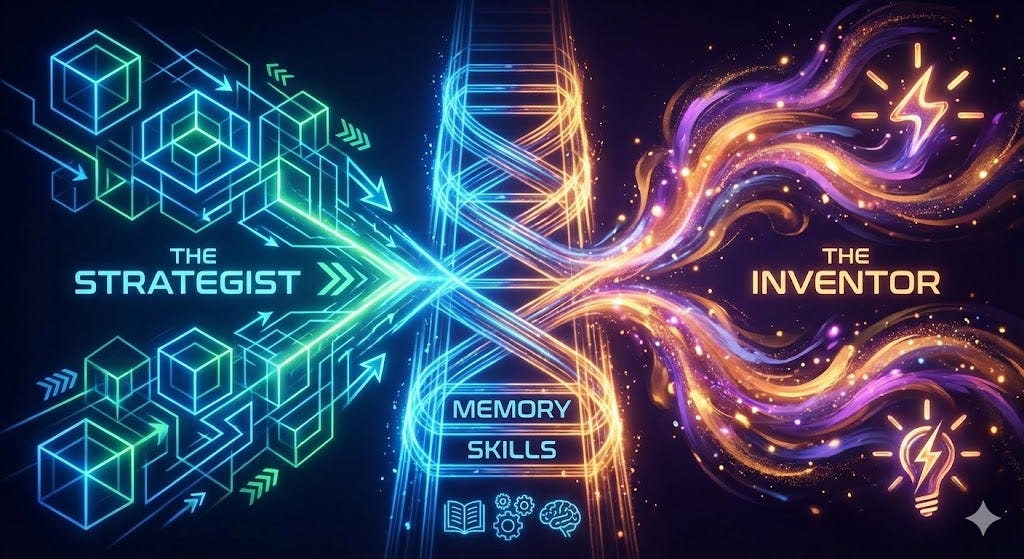
The strategist’s job is to choose which memory approach to use in the moment. It develops a kind of intuition over time about what fits which situation. The inventor’s job is to look at the cases where the strategist keeps struggling and build something new to handle them. When a particular kind of situation keeps going wrong, the inventor notices and creates a new skill.
The system cycles between these two modes: getting better at using what it has, then expanding what it has. There are also safeguards built in. If a newly invented skill turns out not to work, the system rolls back automatically. Nothing is permanently broken by a bad experiment.
What this creates is a genuine feedback loop. The system does not just get better at applying the same strategies. It develops entirely new approaches that nobody explicitly designed.
What the System Discovers on Its Own
The most striking thing about MemSkill is what it develops without being asked.
When working in conversation, the system gravitates toward time-based organization. It starts paying special attention to when things happened and how recent different memories are. When working in environments that involve physical tasks, it develops something completely different: a sense of what has already been tried and what the current state of things is. No one told it to do this. It discovered these strategies because they worked.
What makes this even more interesting is how far the learning transfers. Strategies developed for managing long conversations turn out to be useful for making sense of dense documents. Approaches learned in one AI system work when applied to a completely different one. That kind of generalization suggests MemSkill is learning something real and fundamental about memory, not just picking up surface patterns.
What It Actually Means
The results are straightforward: tested across a wide range of scenarios including extended conversations, complex documents, and physical task simulations, MemSkill outperformed every competing approach the researchers put it up against. When they tried disabling either half of the two-part system, performance dropped noticeably. Both pieces turn out to be genuinely necessary.
For anyone thinking about the future of AI as a collaborative partner rather than a fixed tool, this matters. A system that can evolve its own memory is a system that can grow with you. It adapts to how you communicate, what you care about, and what your shared work actually demands. The explicit, readable skill structure also means that humans can contribute. You could inspect what the system has learned, understand why it is making certain choices, and even offer new approaches based on your own expertise.
The Path Forward
MemSkill is not an incremental improvement. It is a different philosophy about what AI memory should be.
The deeper insight is this: MemSkill goes beyond learning what to remember. It learns how to remember. That distinction represents a real step toward AI systems that improve their own fundamental capabilities over time, not just their performance on a specific task. The same approach could eventually extend to how AI reasons, communicates, and makes decisions.
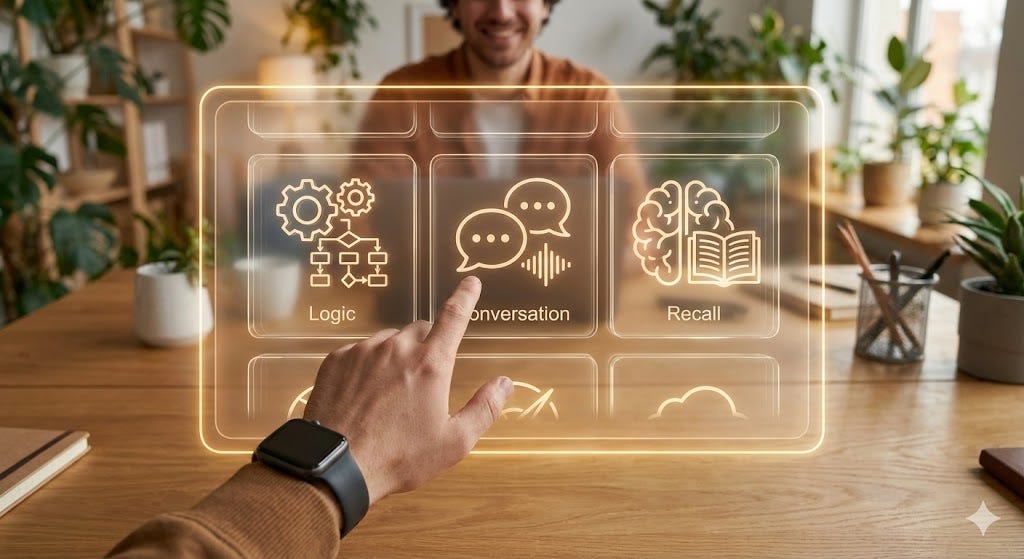
There is also something genuinely collaborative about the direction this points. A system whose learning is transparent and guideable is a system humans can actually work alongside, not just use. Memory skill libraries could be built together, combining what the AI discovers algorithmically with what humans know from experience.
The question is not whether AI can handle today’s tasks. It is whether it can adapt as the relationship deepens and the work grows more complex. MemSkill suggests that kind of adaptability is not a distant aspiration. It is already here.
Source: This post is based on the research paper “MemSkill: Learning and Evolving Memory Skills for Self-Evolving Agents” available at http://arxiv.org/abs/2602.02474v1